Hose for UV printing inks, TYGON® Ink 1000
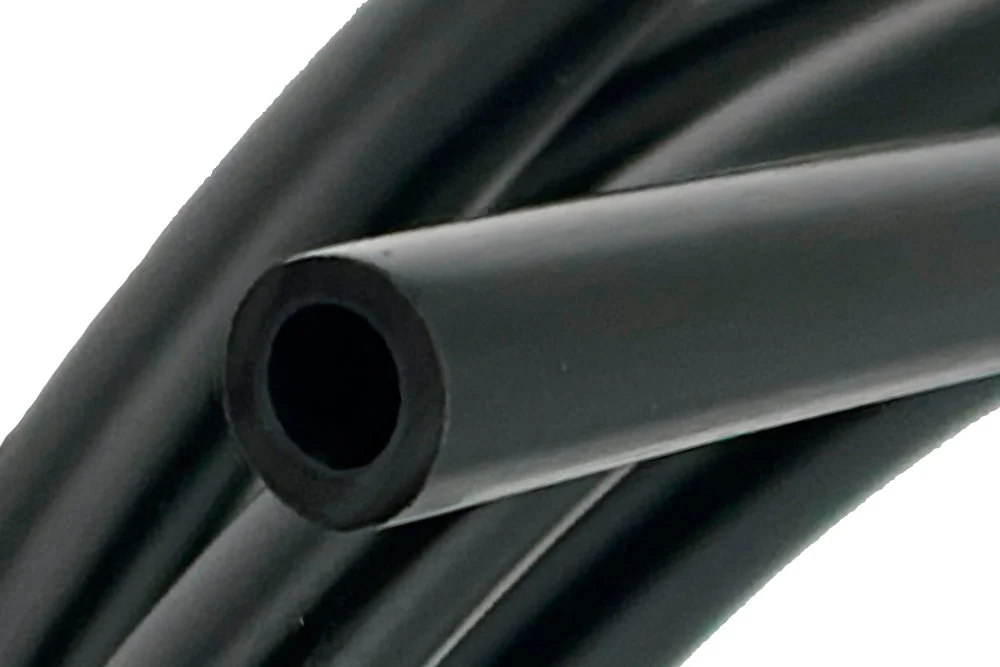
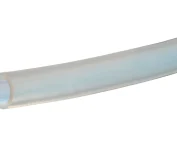
New printing technologies widely introduced in recent years – digital printing, inkjet printing, wide-format printing, packaging printing and 3D printing – use modern UV-curable printing inks (UV inks, UV Ink) containing chemical components that are significantly more aggressive than traditional water- or solvent-based inks. UV inks contain aggressive acrylic monomers that, upon polymerization, form the binder of the ink or the 3D material; commonly used monomers include e.g. IBOA, HDDA, VCAP, VMOX, VEEA, ACMO. UV inks and materials are fed to the print head nozzles at a temperature of 40°C ÷ 50°C and have varying viscosity, from high for 3D printing to low for wide-format printing. Hoses feeding UV ink must have excellent chemical resistance to the ink components, both on the inner and outer side (immersion in the ink). Because the ink thickens and cures under UV radiation, the hose should completely block UV radiation (UV blocking) at wavelengths of 280–400 nm. The mechanical properties of the hose for use in printing machines are also very important: its flexibility, defined as the minimum bend radius and the force needed to bend it, must not be too great, due to the complex shape of its installation for mounting in the print head, and the need for cleaning and disassembly when replacing ink cartridges and during other maintenance activities. Fatigue resistance to bending is especially important in large-format printing, due to the large and fast movements of the print head. Transverse flexibility of the hose, in turn, is important for ease of fitting it onto fittings (the force required to push the fitting in) while maintaining the proper degree of hose clamping on the fitting, for tightness and reliability of the connection. The two-layer TYGON® Ink 1000 hose was developed to optimize all these properties and is characterized by exceptional chemical resistance to commonly used acrylic monomers, UV radiation blocking, flexibility and elasticity, and long service life. Used for all kinds of modern printing systems, such as: digital printing; inkjet printing; wide format printing; packaging printing; 3D printing. Maximum working pressure is given for a temperature of 23°C. Material: polyolefin. Operating temperature: up to +5°C. Inner hardness: 98 Shore (A). Outer hardness: 90 Shore (A). Density: 0.92 g/cm³. Note: Product packed in the Tubes International CLEAN ROOM Clean Zone under strict cleanliness standards. Product is non-returnable.
List of product variants
Do you need a larger quantity of products or a bespoke quote?
New printing technologies widely introduced in recent years – digital printing, inkjet printing, wide-format printing, packaging printing and 3D printing – use modern UV-curable printing inks (UV inks, UV Ink) containing chemical components that are significantly more aggressive than traditional water- or solvent-based inks. UV inks contain aggressive acrylic monomers that, upon polymerization, form the binder of the ink or the 3D material; commonly used monomers include e.g. IBOA, HDDA, VCAP, VMOX, VEEA, ACMO. UV inks and materials are fed to the print head nozzles at a temperature of 40°C ÷ 50°C and have varying viscosity, from high for 3D printing to low for wide-format printing. Hoses feeding UV ink must have excellent chemical resistance to the ink components, both on the inner and outer side (immersion in the ink). Because the ink thickens and cures under UV radiation, the hose should completely block UV radiation (UV blocking) at wavelengths of 280–400 nm. The mechanical properties of the hose for use in printing machines are also very important: its flexibility, defined as the minimum bend radius and the force needed to bend it, must not be too great, due to the complex shape of its installation for mounting in the print head, and the need for cleaning and disassembly when replacing ink cartridges and during other maintenance activities. Fatigue resistance to bending is especially important in large-format printing, due to the large and fast movements of the print head. Transverse flexibility of the hose, in turn, is important for ease of fitting it onto fittings (the force required to push the fitting in) while maintaining the proper degree of hose clamping on the fitting, for tightness and reliability of the connection. The two-layer TYGON® Ink 1000 hose was developed to optimize all these properties and is characterized by exceptional chemical resistance to commonly used acrylic monomers, UV radiation blocking, flexibility and elasticity, and long service life. Used for all kinds of modern printing systems, such as: digital printing; inkjet printing; wide format printing; packaging printing; 3D printing. Maximum working pressure is given for a temperature of 23°C. Material: polyolefin. Operating temperature: up to +5°C. Inner hardness: 98 Shore (A). Outer hardness: 90 Shore (A). Density: 0.92 g/cm³. Note: Product packed in the Tubes International CLEAN ROOM Clean Zone under strict cleanliness standards. Product is non-returnable.
Additional information
| Material | TPE – thermoplastic elastomer |
|---|---|
| Maximum operating temperature [°C] | 55 |
| Vacuum resistance | yes |
| Standard length [m] | 15 |